
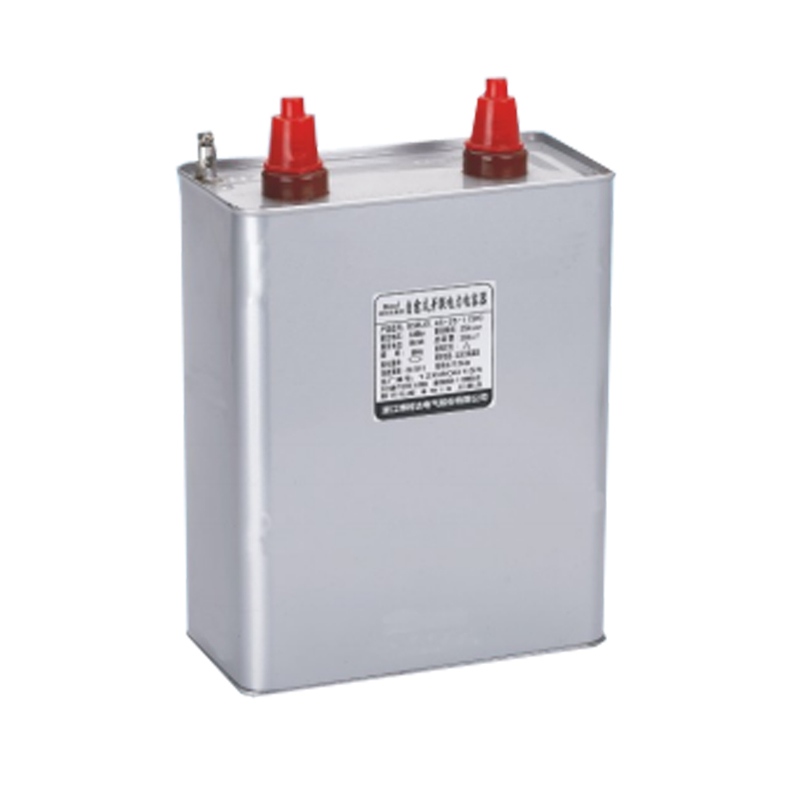
Main uses and scope of application
With the development of reactive power compensation technology, for three-phase unbalanced loads, three-phase capacitors can be switched separately to compensate reactive power in different phases. This makes the compensation accuracy higher and the power saving effect better. For this reason, our company has developed a shunt capacitor with split-phase compensation, and its shell is provided with a neutral point lead-out terminal, which can conveniently realize the split-phase switching of the capacitor.
For the structural features, main technical parameters and ordering instructions of this product, please refer to the technical overview of self-healing low-voltage shunt capacitor of our company.
Working conditions
After the capacitor is cut off from the power supply, it is necessary to ensure that the residual voltage of the capacitor is reduced to 10% of the rated voltage before it can be put into operation again. Usually, this time is about 200s, so the controller should be selected with a forced delay function after being cut off. If a general controller is used, it is necessary to install a quick discharge facility, and the equipotential switching controller is not subject to this restriction.
Altitude ≤2000m, ambient temperature category-25/c. The lowest temperature is -25℃, and the highest temperature is Class C (the highest temperature does not exceed 50℃, the average temperature within 24 hours does not exceed 40℃, and the average temperature within one year does not exceed 30℃). Capacitors should work under good ventilation conditions and are not allowed to work in a closed and unventilated environment.
Architectural feature
Three single-phase capacitors are connected into Y- connection neutral point and led out (marked with N terminal), which constitutes three single-phase common capacitors. When in use, AN, BN and CN are independent units. Each independent unit is connected with a discharge resistor, which is safer to use. The damage of any independent unit is connected with overvoltage isolation device, which can be reliably disconnected.
Note: Of course, capacitors with three single-phase independent units can also be used for split-phase compensation. The three single-phase common capacitors in this section have the characteristics of small occupation volume and convenient use, and are favored by users.


